
Last Updated on September 16, 2024 by Christine Kaaloa
In Korea, it often feels like there are never any really fat Koreans (…okay, they are exceptions; but it’s rare)! Obesity is not a chronic problem in Korea, as it is in the west. One theory is owned to how Koreans eat healthy. Korea may have restaurant chains like McDonalds and Burger King, but they aren’t a ‘fast food’ kind of country.
Frozen or microwave foods ? Koreans like their food fresh.
Preservatives? The keyword is fermented.
Koreans do however, occasionally like their meals served simple, cheap and pali! pali (fast)!
Kimbap restaurants chains are the healthy equivalent to fast food joints.
Table of Contents: How to order at a Kimbap Restaurant, the healthy fast food joints in Korea
- 1 Kimbap restaurants chains are the healthy equivalent to fast food joints.
- 2 How to order at a kimbap restaurant:
- 3 How to place an order at a kimbap restaurant:
- 4 How to order Korean food you’re a Vegetarian: To baego or not to baego
- 5 Where are the utensils at a kimbap restaurant?
- 6 How to recognize a kimbap shop?
- 7 Have you ever eaten at a kimbap restaurant?
The meals they sell are often thought of as “simple home foods”, which are made quickly and sold cheaply. Most of the dishes on the menu is under 5,000 won. Kimbap (sushi rolls), jigae (stews), ramen or udon (noodles dishes) and rice meals such as bibimbap are all standard platter of most kimbap shops (photo examples here). Order it as takeout or dine in; either way, your dish comes with a small plate of panchan (or side dishes).
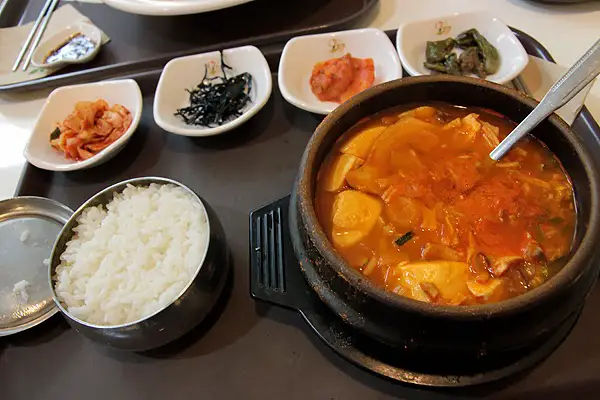 Soon dubujigae with banchan side dishes.
How to order at a kimbap restaurant:
At first you may not know how to place an order at a kimbap shop. Are there picture menus or menus in English? Hah! Does the outdoor sign read : K-I-M-B-A-P ? Seldom. So how does one recognize a kimbap shop or order from it?
• Memorizing the menu
Let’s say you don’t read a lick of hangul. Knowing what you want and how to order is all you need to know!
Until you can read Korean, memorize the names of the foods you’ll want to order. Maryeats.com has an excellent breakdown and translation of Kimbap Nara‘s menu (a brand of kimbap joints) and Katie’s Korean Adventure has examples of the food in kimbap restaurants .
• Decoding the Menus
Staring at the menus might have a dizzying effect– they look like a Korean multiple choice quiz– until you realize they’re organized by category. Recognizing the categories above will help you locate your dishes quicker. They might change slightly according to restaurant, but they typically range from:
- 김밥 kimbap = sushi rolls
- 식사 shiksa = general meals (with or without rice)
- 찌개 ji-gae = soups
- bunshik = meals with noodles
i.e. 라면 ramyeon = ramen noodles 우동 udon = thick white noodles
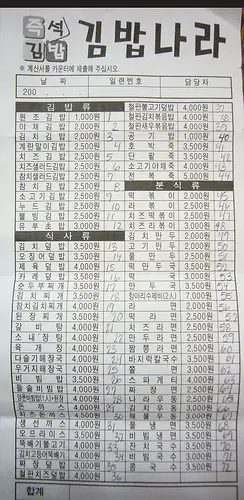
Photo credit: Maryeats.com. A kimbap restaurant menu. The numbers in the boxes are the number count of dishes on this menu. There are 72 dishes.
How to place an order at a kimbap restaurant:
Placing at an order at a kimbap restaurant isn’t hard. When you roll in and sit down, you’ll see a menu pad on the edge of your table. Check the item and quantity you want in the item box or you can order it directly from the ajumma waitress. Your ajumma may be sweet or a bit rough around the corners, as if life’s dealt her more blows than a NYC waitress. Don’t take it personally; that’s just ajummas, in general!
If you know what you want, then you can rattle it off:
• ” ……. issoyo?” (Do you have ……?)
• “……. chuseyo” (…….., please)
How to order Korean food you’re a Vegetarian: To baego or not to baego
If you’re a vegetarian, you’d probably want to know how to order korean food.
Generally, every dish will have a bit of fish or seafood splash to it. If you want to remain meat and ocean-free, then kimbap (sushi roll) is your best bet (approx. $1.30-$2.00, it’s also the cheapest thing on the menu)! But you’ll still have to baego it. Baego means the equivalent to “without” or “hold”. Knowing it has been a life-saver.
• Baego kieran (without egg)
• Baego kogi (without meat)
For instance, I might say:
“Yache kimbap chuseyo. Baego keran, baego kogi.”
( Translation: I’ll have vegetable kimbap, please. Hold the eggs, hold the meat)
Then watch to see if they prepare it the way you asked. Koreans don’t always see eggs and seafood as “meat” so you’ll have to watch them as they make it. Sometimes, I don’t think they even see ham as meat because occasionally, I’ll catch an ajumma sneaking it in.
Vegetarians will have a challenge with ordering Korean food, but once you get the hang of it, it gets a little easier.
.
Where are the utensils at a kimbap restaurant?
Your waitress has come with your dish, drops it before you and walks away. Where are the chopsticks? Can I at least get a napkin?
At a kimbap restaurant, it’s all self-serve when it comes to utensils. There will be a wooden or plastic box and if you lift the lid, you’ll see metal chopsticks and spoons.
.
How to recognize a kimbap shop?
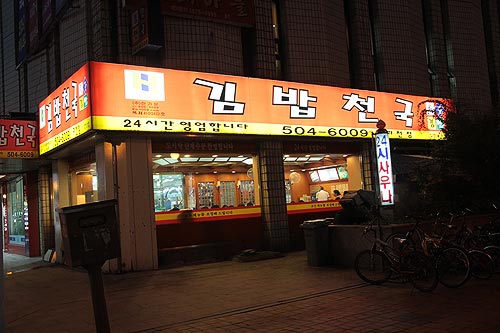
Kimbap restaurants usually have franchises or chains and they seem to be everywhere. How do you recognize one? They almost always have blasting signs if you pay attention. On the outside:
- A garishly, bright orange sign which have the word 김밥 kimbap.
- Open 24 hours: You’ll see “24” somewhere in their advertising.
- You may see happy, dancing kimbap painted on window or signs.
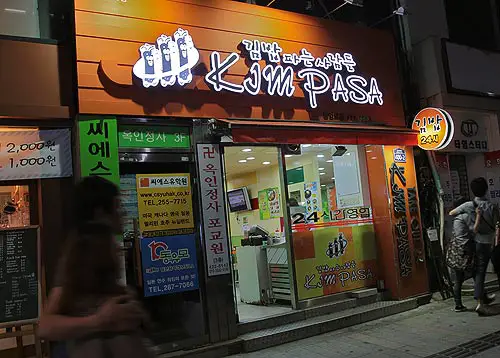
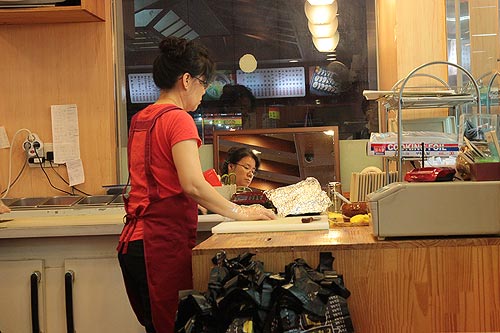
- Inside, there’s a kimbap counter near the door entrance, as kimbap is the quickest takeout food to serve. The a counter with all the kimbap fixings.
Have you ever eaten at a kimbap restaurant?